





Local Advice for Edmonton Business Owners and Property Managers
Published: August 2026 | Author: Serene Landscaping | Reading time: 18 minutes
Commercial snow removal in Edmonton is not simply a matter of sending a plow after a storm.
A reliable winter maintenance program must keep parking lots usable, entrances accessible, sidewalks clear, loading areas operational, and ice under control throughout changing weather conditions. It also needs to define exactly when service begins, which areas receive priority, how quickly the contractor responds, where accumulated snow will be stored, and what happens when those storage areas become full.
Those details belong in the contract before the first snowfall.
A vague agreement promising that snow will be removed "as needed" may sound flexible in September. It becomes much less reassuring when customers arrive to an icy entrance, delivery vehicles cannot reach the loading zone, and nobody can determine whether the contractor has actually been dispatched.
This guide explains how commercial snow removal contracts work in Edmonton, what affects the price, which services should be included, how service triggers and response times should be written, and what business owners, condo boards, and property managers should verify before signing.
What Should a Commercial Snow Removal Contract Include?
A complete commercial snow removal contract should define:
- The contract term and service dates
- The snow accumulation trigger
- How and where accumulation is measured
- Required response and completion times
- Parking-lot plowing responsibilities
- Sidewalk, stairway, and entrance clearing
- Ice monitoring and de-icing
- Sanding or traction control
- Snow-pile locations
- Snow-hauling rates and triggers
- Priority and emergency-access areas
- Service records and photographs
- Equipment and backup capacity
- Insurance and WCB coverage
- Property-damage procedures
- Pricing, minimum charges, and exclusions
- Contact and escalation procedures
Serene Landscaping currently provides commercial snow removal for parking lots, walkways, loading zones, and building entrances across Edmonton, St. Albert, and Sherwood Park. Its seasonal commercial clients receive priority dispatch, with crews monitoring conditions and responding when the contracted accumulation threshold is reached.
The best contract is not necessarily the longest one. It is the one that answers the practical questions before a storm creates them.
Commercial Snow Removal Versus Commercial Snow Plowing
Snow plowing and snow removal are related, but they do not describe the same scope.
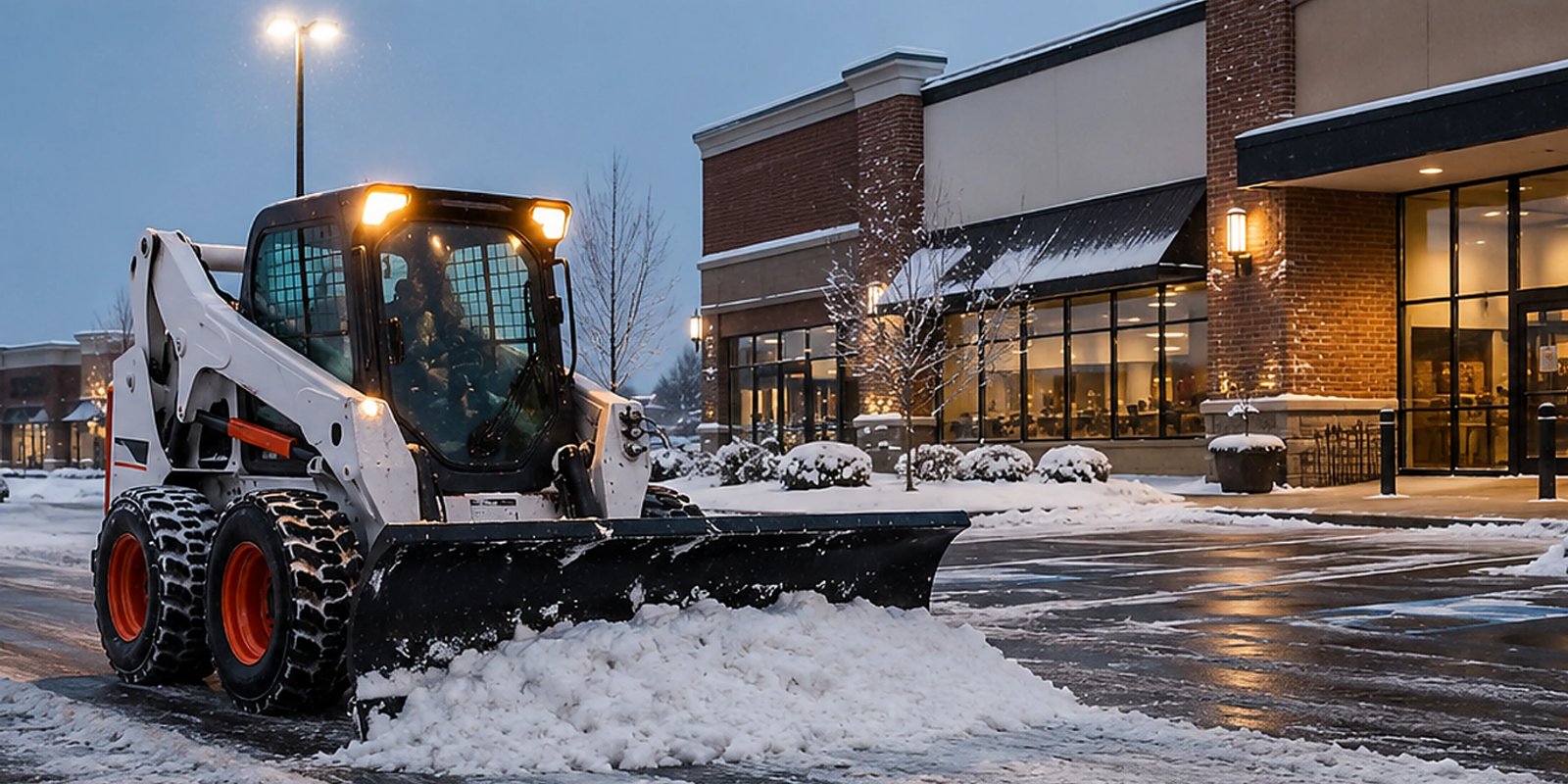
Commercial snow plowing usually refers to pushing snow off driving and parking surfaces with a truck, skid steer, loader, or similar equipment.
Commercial snow removal is the broader winter-management service. It may include:
- Parking-lot plowing
- Sidewalk and entrance clearing
- Hand shovelling
- Snow blowing
- Ice inspection
- De-icer application
- Lot sanding
- Snow stacking
- Snow loading and hauling
- Emergency response
- Service reporting
- Follow-up visits during continuing storms
A commercial property can be plowed and still remain unsafe or difficult to use.
A cleared driving lane does little for a customer who cannot cross an icy sidewalk. A clean entrance does not solve snow piles blocking sightlines at the parking-lot exit. A loading dock may be technically accessible while packed snow prevents a truck from positioning properly.
A complete commercial snow removal plan looks at how vehicles and people use the entire site.
How Much Does Commercial Snow Removal Cost in Edmonton?
Commercial snow removal costs in Edmonton vary substantially because commercial properties do not follow one standard layout.
A small professional office with ten parking stalls and one entrance requires a different combination of equipment and labour than a shopping centre, industrial yard, medical facility, restaurant, warehouse, or multi-building condominium complex.
Serene Landscaping currently publishes the following commercial starting rates:
| Commercial service | Published starting price |
|---|---|
| Heavy skid steer, on call | From $140 per hour |
| Skid steer minimum | Three hours |
| Snow hauling | From $350 per hour |
| Snow-hauling minimum | Three hours |
| Dump fee | $75 per 10-yard truck |
| Lot sanding | Approximately $180 to $500 |
| Seasonal or monthly contract | Quoted by square footage and scope |
| Emergency response | Available, with contract clients prioritized |
These are Serene Landscaping's published starting rates, not universal Edmonton market averages. Final prices depend on the property, access, service level, accumulation, equipment requirements, and amount of handwork. Serene provides a written commercial proposal after reviewing the site rather than attempting to price a complex property from a brief telephone description.
Why Commercial Snow Removal Is Usually Quoted After a Site Visit
Square footage matters, but it is only one part of the calculation.
Two parking lots with the same area can have very different winter-maintenance costs.
One may be a simple rectangular lot with wide entrances and open perimeter space for stacking snow. The other may contain narrow lanes, parking islands, loading bays, cart corrals, landscaped medians, accessible stalls, multiple entrances, and no practical snow-storage area.
The second property will require more turns, more hand clearing, more detailed equipment work, and potentially more hauling.
A commercial site assessment allows the contractor to identify:
- Total plowable area
- Sidewalk and pedestrian-route length
- Number of entrances and stairs
- Parking-lot islands
- Loading and delivery areas
- Fire and emergency routes
- Accessible parking and ramps
- Snow-storage locations
- Drainage structures
- Curbs and landscape edges
- Low-clearance areas
- Gates and access codes
- Overnight vehicle parking
- Equipment requirements
- Neighbouring properties
- Areas sensitive to salt or mechanical damage
The contractor can then prepare a scope that reflects how the site actually operates.
For a smoother walkthrough, use Serene Landscaping's guide to prepare your property for snow removal before the site assessment.
What Affects Commercial Snow Removal Pricing?
Property Size
Larger parking areas generally require more equipment time, fuel, labour, and material.
However, size alone does not determine the cost. A large open lot can sometimes be cleared more efficiently than a much smaller but heavily divided property.
Amount of Hand Clearing
Sidewalks, stairs, entrance pads, wheelchair ramps, narrow passages, and areas around doors often require hand crews or smaller equipment.
Hand clearing costs more per square metre than moving snow across an open parking lot because it requires more labour and detail.
Properties with several storefronts or building entrances should confirm whether every doorway is included or only designated main entrances.
Snow Accumulation Trigger
The service trigger is the accumulation level that activates the contractor.
A lower trigger usually produces more visits and better ongoing access. It may also increase the seasonal or per-event price.
A higher trigger may reduce the number of plowing events, but it can allow snow to become packed by vehicles and pedestrians. Packed snow can be more difficult to remove and may create additional ice-control work.
The right trigger depends on the property's use rather than a single universal number.
Required Response Time
A retail property opening at 7 a.m. may require overnight service before employees and customers arrive.
An industrial yard operating continuously may require ongoing access throughout the storm.
An office that remains closed overnight may tolerate a different completion schedule.
Faster or guaranteed response times affect route planning and pricing because the contractor must reserve labour and equipment capacity for the site.
Serene Landscaping states that its seasonal commercial clients are generally cleared within two to four hours after accumulation reaches the contracted threshold. Non-contract emergency and per-push work is subject to availability, with contract sites receiving priority.
Ice-Control Requirements
Ice management may include:
- Salt
- Calcium chloride
- Sand
- Gravel or traction material
- Spot treatment
- Full-lot treatment
- Pre-treatment before freezing conditions
- Follow-up visits after thawing and refreezing
A property requiring repeated inspections and applications will cost more than one where ice control is only applied after plowing.
Materials, application rates, surface conditions, drainage, landscaping, and temperature all affect the appropriate treatment.
Snow Storage and Hauling
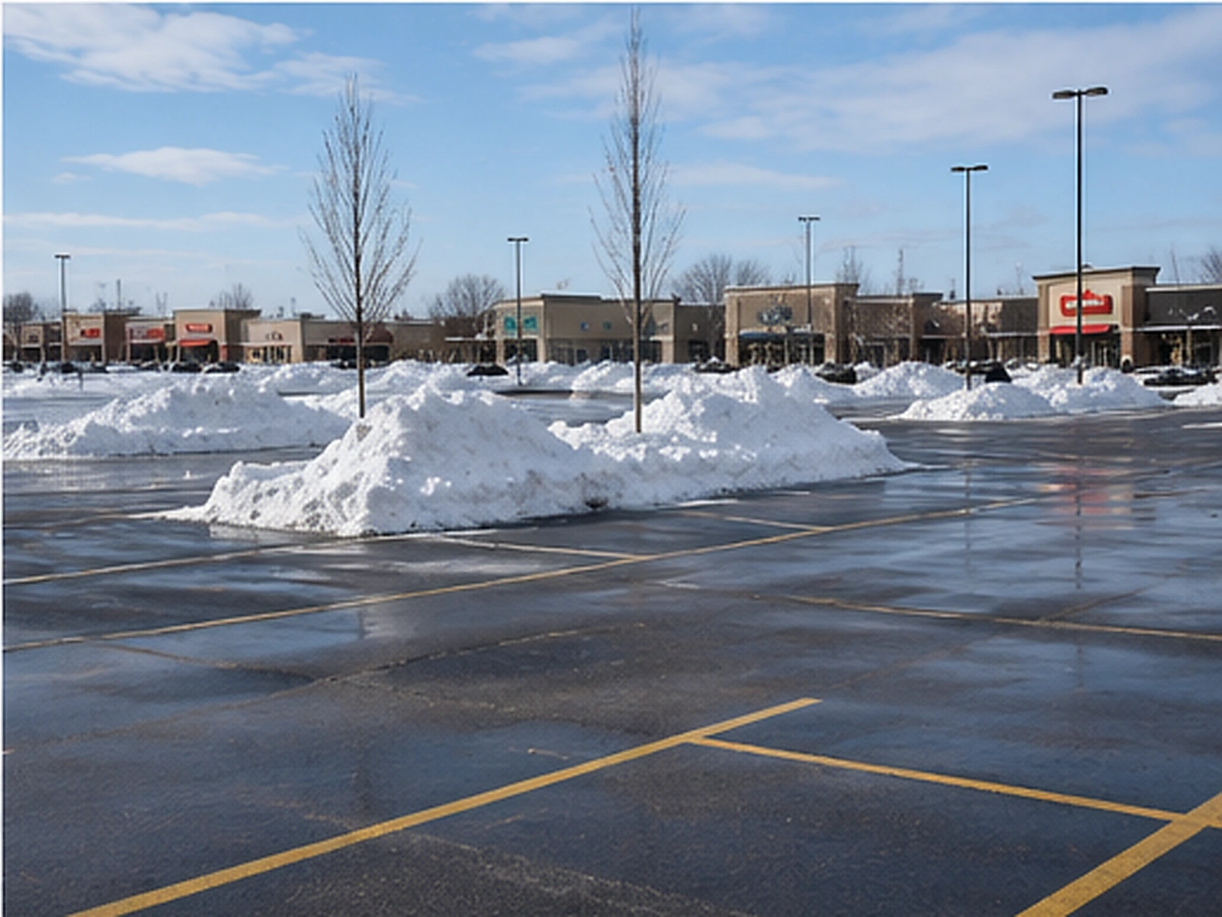
Pushing snow to an on-site storage area is generally less expensive than loading and hauling it away.
The cost changes when snow piles begin:
- Occupying valuable parking stalls
- Blocking entrances
- Restricting delivery access
- Reducing visibility at exits
- Covering fire hydrants
- Blocking drainage
- Encroaching on neighbouring property
- Creating meltwater across walkways
- Interfering with signs or lighting
A good commercial contract identifies storage areas and hauling rates before space becomes a mid-winter emergency.
Obstacles and Parked Vehicles
Vehicles left in service areas force operators to work around them and return later.
Other obstacles can include:
- Curbs
- Bollards
- Wheel stops
- Concrete islands
- Signs
- Planters
- Shopping-cart corrals
- Low landscape walls
- Utility covers
- Drain grates
- Speed bumps
- Loading equipment
- Waste containers
These features should be marked before winter so operators can work efficiently without damaging the property.
Property Hours
A contractor may have only a narrow window to clear a busy property.
Restaurants, grocery stores, medical facilities, hotels, warehouses, and 24-hour businesses require different routing than sites that remain vacant overnight.
A commercial contract should state when the lot is normally least occupied and which areas must remain available during service.
Commercial Snow Removal Pricing Models
Commercial snow removal companies generally use one or more of the following pricing structures.
Seasonal or Monthly Flat-Rate Contracts
A seasonal contract charges a defined amount for an agreed winter period.
The contract may be invoiced monthly even though the price covers the full season. Qualifying snow events are serviced automatically according to the agreed trigger and scope.
Serene Landscaping describes its seasonal commercial option as a flat monthly arrangement covering qualifying snowfall events, with budget certainty and priority dispatch. The exact scope and pricing are confirmed in the written site proposal.
Advantages
- Predictable budgeting
- Automatic dispatch
- Priority routing
- No need to authorize each visit
- Easier management across repeated storms
- Consistent service expectations
- Reduced risk of being unable to find a contractor during a major storm
Potential limitations
- The property pays the contracted amount during mild periods
- Some services may remain outside the base rate
- Hauling or excessive accumulation may be charged separately
- Ice control may have included limits or application charges
- The contract may define specific accumulation caps or exclusions
Seasonal pricing is usually best suited to properties where access must remain reliable regardless of snowfall frequency.
Per-Push or Per-Event Pricing
Per-push service charges the property each time the contractor performs a qualifying clearing.
The price may be based on:
- A fixed rate per visit
- Snow-depth ranges
- Equipment hours
- Labour hours
- Separate plowing and sidewalk charges
- Separate ice-control applications
Advantages
- Payment is tied to actual service events
- A mild winter may cost less
- Useful for lower-priority or lightly used properties
- Can work for properties with in-house staff handling smaller events
Potential limitations
- Costs become less predictable during a heavy winter
- Each service or return visit may create another charge
- Non-contract properties may receive lower priority
- Major storms can produce several billable operations
- Emergency availability is not guaranteed
Per-push service should still use automatic dispatch if uninterrupted access is important. Requiring the property manager to call after every snowfall introduces delay at exactly the moment contractors are busiest.
Hourly and On-Call Service
Hourly service is commonly used for:
- Skid steer work
- Loader work
- Emergency clearing
- Snow-pile relocation
- Hard-packed snow removal
- Loading and hauling
- One-time property cleanups
- Properties changing contractors mid-season
Hourly service often has a minimum charge because equipment must be mobilized, transported, operated, and returned.
Serene Landscaping's published on-call skid steer rate begins at $140 per hour with a three-hour minimum. Snow hauling begins at $350 per hour with a three-hour minimum, plus applicable dump fees.
Hourly service can be useful for unexpected work, but it is usually less suitable as the entire winter strategy for a property that must remain consistently open.
Hybrid Agreements
Some properties use a combination of:
- A seasonal base fee
- Per-event plowing charges
- Separate ice-control charges
- Separate hauling rates
- Hourly emergency work
A hybrid structure can fit unusual properties, but the contract must clearly state which services are included and which will generate additional invoices.
Otherwise, the property manager may have budget certainty only in the decorative sense.
How Commercial Snow Removal Service Triggers Work
A service trigger tells the contractor when to begin work.
For example, a contract might activate parking-lot plowing when accumulation reaches an agreed depth while calling for walkway treatment at a lower accumulation or whenever freezing conditions create unsafe surfaces.
The contract should answer five questions:
- What accumulation activates service?
- Where is the snow measured?
- Does drifting count?
- Does the contractor begin during the storm or after it stops?
- When are follow-up visits required?
Lower triggers
Lower triggers are generally appropriate for:
- Medical and healthcare facilities
- Retail properties
- Restaurants
- Hotels
- Childcare facilities
- Senior housing
- High-traffic office sites
- Properties with steep entrances or sensitive pedestrian routes
They provide more frequent clearing but increase service frequency and cost.
Higher triggers
Higher triggers may be appropriate for:
- Low-traffic storage yards
- Properties closed during storms
- Sites with in-house staff handling minor accumulation
- Areas that do not require continuous public access
A higher plowing trigger does not eliminate the need to monitor ice. A thin snowfall can become hazardous when it is compressed, melted, and refrozen.
Response Time Must Be Measurable
Terms such as "prompt," "reasonable," and "as soon as possible" are difficult to enforce between a client and contractor because they do not establish a measurable service commitment.
A stronger contract defines:
- Dispatch time after the trigger
- Target arrival window
- Completion target
- Priority zones
- Return visits during ongoing snowfall
- Procedures for extreme storms
- Emergency contact escalation
- Communication when service is delayed
The completion target should also state whether time is measured from:
- The beginning of snowfall
- The end of snowfall
- The moment the accumulation trigger is reached
- The business opening time
- A specific dispatch notice
Serene's commercial service page states that seasonal clients are typically serviced within two to four hours after the contracted accumulation threshold is reached.
Need a Commercial Snow Removal Contract?
Get a site assessment and a detailed winter-maintenance proposal built around your property's response-time needs.
Priority Areas for a Commercial Property
Not every part of a commercial site has equal urgency.
A winter plan should identify first-priority areas such as:
- Fire exits
- Main vehicle entrances
- Emergency access
- Accessible parking stalls
- Accessible ramps
- Main pedestrian routes
- Building entrances
- Loading bays
- Garbage and service access
- Drive-through lanes
- Employee entrances
- High-traffic intersections within the lot
Secondary parking rows and low-use areas may be cleared afterward.
This sequence should be mapped during the pre-season site visit, not improvised by the equipment operator at 3 a.m.
What Should Be Included in Commercial Snow Removal?
Parking-Lot Plowing
Parking-lot plowing should maintain vehicle access while avoiding:
- Blocked fire routes
- Buried accessible stalls
- Snow pushed against buildings
- Obstructed loading areas
- Lost visibility at entrances
- Snow deposited on neighbouring property
- Snow pushed into public roads
- Piles covering drainage structures
Operators should follow the pre-approved stacking plan and preserve enough space for future snow events.
Sidewalk and Walkway Clearing
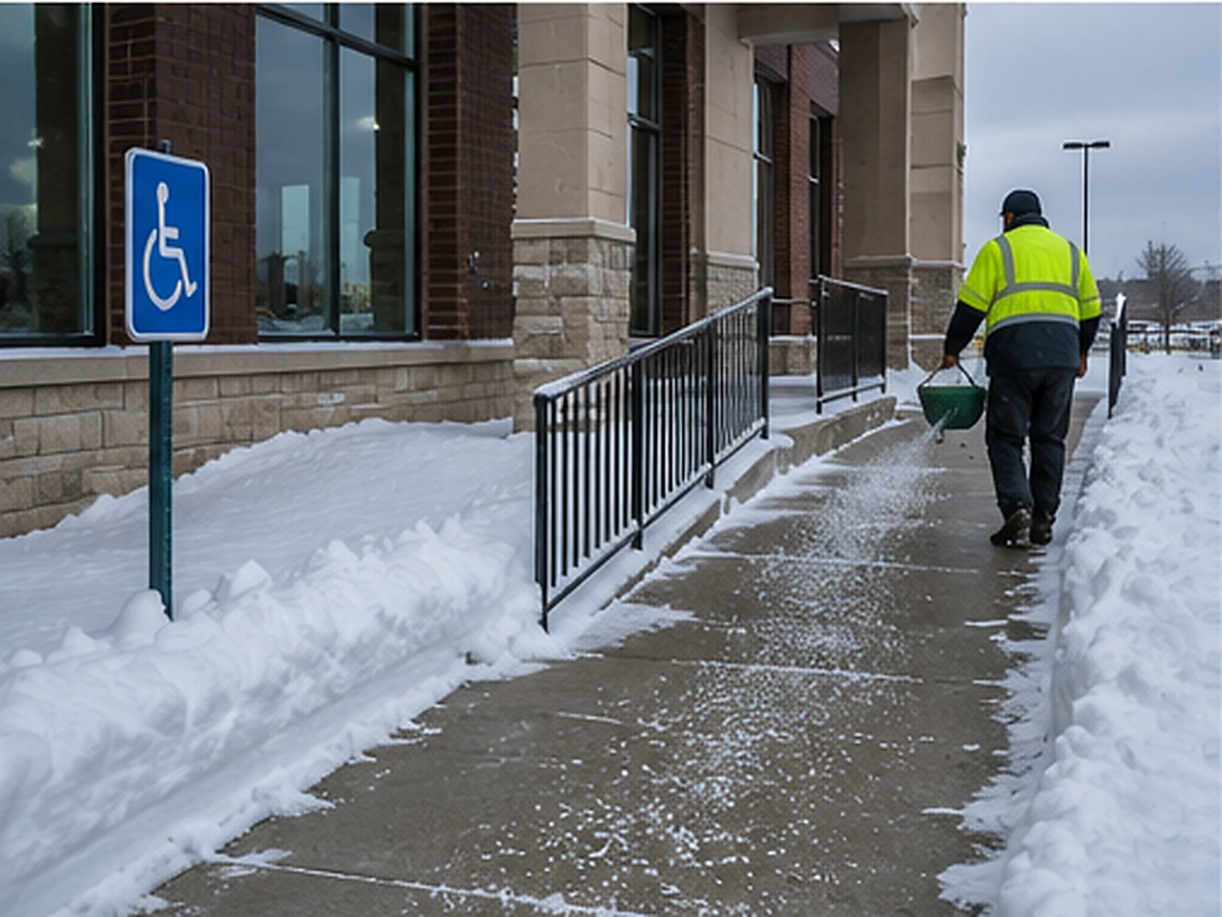
The scope should identify every pedestrian surface included in the contract:
- Public sidewalks adjacent to the property
- Private walkways
- Storefront approaches
- Steps
- Entrance pads
- Accessible ramps
- Internal pedestrian routes
- Paths to garbage areas
- Employee access routes
- Emergency exits
Serene's commercial program includes sidewalk, walkway, entrance, and high-traffic pedestrian clearing. Its service page also includes de-icing and sanding options for entrances, steps, and larger surfaces.
Entrance Maintenance
Building entrances require more detailed attention than open parking surfaces.
Snow tracked inside can create wet floors, while compacted snow outside can become difficult to remove. Roof runoff, heated doorways, exhaust vents, and repeated foot traffic can also create localized ice.
Entrance maintenance may include:
- Hand shovelling
- Scraping packed snow
- De-icer application
- Sanding
- Reinspection
- Clearing around automatic doors
- Maintaining accessible thresholds
The contract should identify whether entrance treatment is completed during every visit or only when requested.
Ice Control and Sanding
Plowing removes snow. It does not automatically remove bonded ice or prevent future freezing.
Ice management may be required:
- After plowing
- During freezing rain
- After daytime melting
- Near downspouts
- Around roof-drip areas
- At shaded entrances
- On slopes
- Near compacted traffic areas
- Around loading docks
- Where vehicles track snow onto cleared pavement
Sand and de-icing products serve different purposes.
Sand improves traction but does not melt ice. Chemical de-icers can melt or weaken ice, but the correct material and application rate depend on temperature, pavement, landscaping, drainage, and operational needs.
A contract should state whether materials are:
- Included in the seasonal price
- Charged per application
- Charged by weight
- Limited to specific areas
- Applied automatically
- Applied only with client approval
Snow Hauling
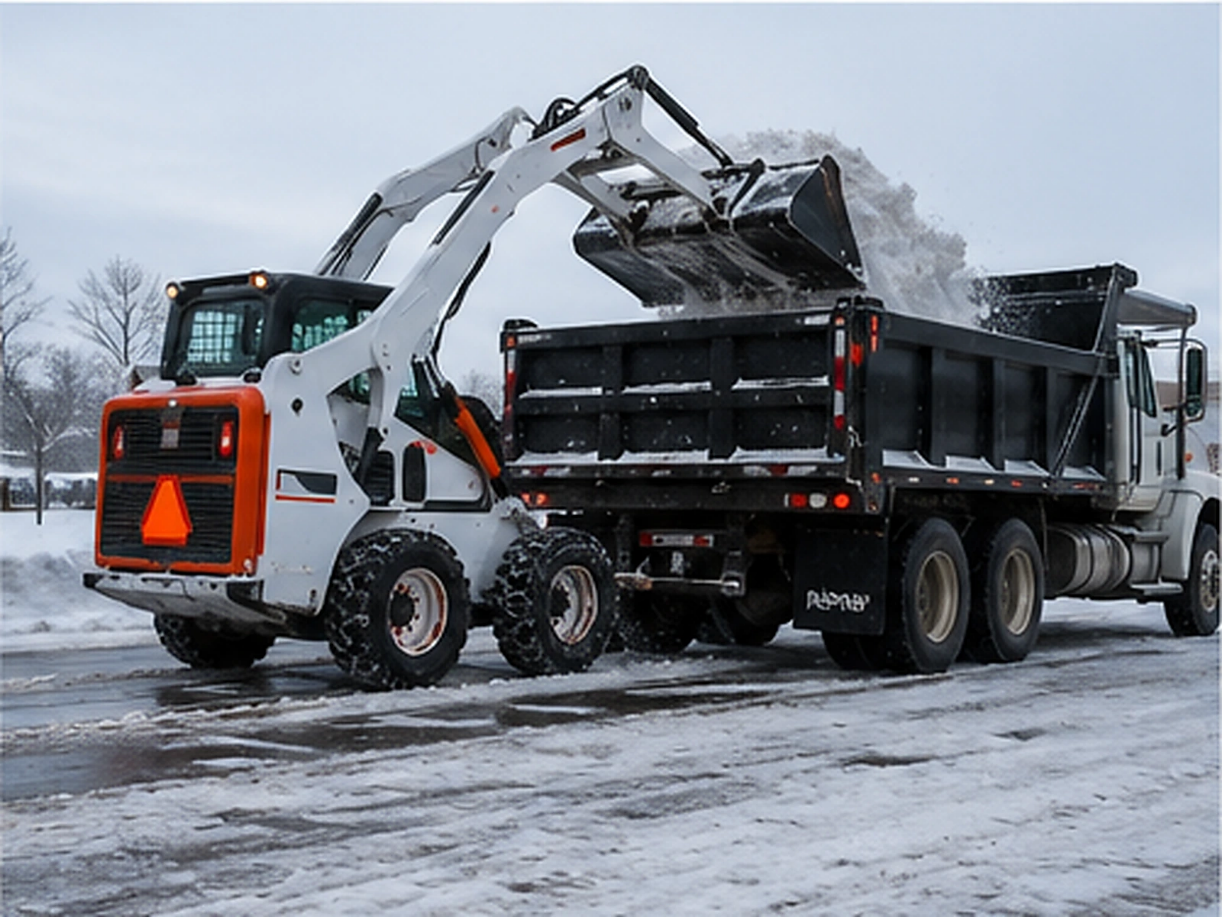
Snow hauling becomes necessary when on-site storage is no longer practical.
The contract should define when hauling may be authorized. Possible triggers include:
- A specified number of parking stalls being lost
- Snow piles exceeding a defined height
- Reduced visibility at driveways
- Blocked signs or lighting
- Restricted emergency access
- Meltwater flowing across walkways
- No remaining approved stacking location
The City of Edmonton prohibits placing cleared snow onto the roadway. It directs property owners without sufficient storage space toward approved snow-storage facilities. The City also states that putting snow from a private driveway or walkway onto the road can result in a $250 fine.
Emergency Snow Removal
Emergency service may be required when:
- A previous contractor fails to attend
- A lot becomes inaccessible
- Snow piles block deliveries
- Hard-packed snow requires heavy equipment
- Ice creates an immediate pedestrian hazard
- The property must reopen after a closure
- A major snowfall exceeds normal equipment capacity
Emergency work is usually more expensive than planned seasonal service because equipment and labour must be inserted into an already active route.
Serene Landscaping offers emergency and per-push commercial service, although seasonal contract clients receive first priority.
Edmonton Snow and Ice Responsibilities for Commercial Properties
Edmonton's Community Standards Bylaw states that a person must maintain any sidewalk adjacent to land they own or occupy clear of all snow and ice. The requirement applies to sidewalks beside commercial properties as well as residential ones.
The City's current guidance says:
- Snow and ice should be removed as quickly as possible
- The sidewalk should be cleared for its entire width and length
- The target standard is the underlying cement or asphalt
- Sand, gravel, or ice melt can be used temporarily
- Failure to maintain sidewalks may result in a $100 fine plus clearing costs
- The City does not clear most sidewalks in residential or commercial areas
The often-repeated "48-hour rule" is not the wording of the bylaw. Complaints are generally accepted after at least 48 snow-free hours, but that does not create permission to leave a hazardous sidewalk untreated until hour 47.
Commercial property owners and managers should build their service standards around safe and practical access, not around waiting for the complaint process to become available.
Commercial Property Liability and Winter Maintenance
Alberta's Occupiers' Liability Act provides that an occupier owes visitors a duty to take reasonable care, considering the circumstances, to see that visitors are reasonably safe while using the premises for permitted purposes.
Hiring a contractor is an important part of winter-risk management, but the existence of a contract does not mean the property manager can stop monitoring the site.
A responsible winter-maintenance process may include:
- Clear contractor responsibilities
- Regular inspections
- Service records
- Weather monitoring
- Incident procedures
- Staff reporting channels
- Prompt correction of recurring ice
- Documentation of material applications
- Escalation when the contractor misses a service target
This article provides general operational information, not legal or insurance advice. Commercial owners and property managers should review contract and liability requirements with their insurer or legal adviser.
Why Service Documentation Matters
A property manager should be able to determine:
- When the contractor arrived
- Which areas were serviced
- What equipment was used
- Whether ice control was applied
- What material was applied
- Whether a follow-up visit was required
- Whether a hazard was reported
- When the site was inspected again
Useful records may include:
- Timestamped photographs
- Operator notes
- Arrival and departure times
- Weather conditions
- Material logs
- Site maps
- Incident reports
- Client communications
- Follow-up instructions
Documentation helps verify invoices, manage tenant questions, identify recurring site problems, and establish a consistent operational record.
Serene's commercial service includes site reporting and clear communication regarding the work completed after snow and ice events.
Snow Removal for Different Commercial Properties
Retail and Shopping Properties
Retail locations require:
- Clear customer entrances
- Safe cart-return routes
- Accessible stalls
- Clear parking rows
- Strong visibility at exits
- Early-morning or overnight service
- Frequent ice checks
- Snow storage that does not consume customer parking
The contractor should understand opening hours, delivery schedules, and peak shopping periods.
Offices and Professional Buildings
Office properties often prioritize:
- Employee arrival routes
- Main entrances
- Accessible parking
- Public sidewalks
- Visitor parking
- Underground parkade approaches
- Early completion before business hours
A daytime refreeze plan may also be needed where sun exposure melts piled snow and sends water across walkways.
Medical and Healthcare Properties
Medical facilities require a lower tolerance for inaccessible or slippery surfaces.
Priority areas may include:
- Patient drop-off zones
- Accessible routes
- Ambulance or service access
- Ramps
- Main entrances
- Staff entrances
- Emergency exits
Response times and ice inspections should be written clearly because these properties may operate beyond normal business hours.
Industrial Properties and Warehouses
Industrial sites may require:
- Loading-dock access
- Trailer manoeuvring space
- Gate access
- Employee parking
- Heavy-equipment lanes
- Fire routes
- Yard sanding
- Snow hauling
- Overnight or continuous service
The contractor should understand where snow can be stacked without limiting truck movement or blocking drainage.
Condominium and Multi-Residential Properties
Condominium boards and property managers often need one contract covering:
- Internal roads
- Visitor parking
- Resident walkways
- Garbage access
- Mail areas
- Building entrances
- Fire exits
- Accessible routes
- Public sidewalks
The agreement should state whether individual-unit approaches, patios, or assigned stalls are included.
Communication is especially important because residents may report service concerns through several board members, managers, or building representatives. The contract should designate one operational contact whenever possible.
Restaurants and Hospitality Properties
Restaurants and hotels often operate during evenings, weekends, and storms.
Their winter plans may prioritize:
- Customer entrances
- Delivery access
- Takeout and pickup areas
- Employee entrances
- Drive-through lanes
- Loading areas
- Waste access
- Overnight parking
- Continuous ice monitoring
Snow removal should be scheduled around customer traffic without allowing the property to become inaccessible before service begins.
What to Review During the Pre-Winter Site Walkthrough
A pre-season walkthrough should be completed before the ground is covered.
The property manager and contractor should review:
Property boundaries
Confirm which sidewalks, drive lanes, parking areas, and entrances belong to the property.
Priority zones
Mark accessible routes, fire exits, loading docks, main entrances, and other critical areas.
Snow-storage locations
Choose areas that will not:
- Block visibility
- Cover signs
- Occupy essential stalls
- Obstruct drainage
- Damage landscaping
- Block hydrants
- Send meltwater toward entrances
Obstacles
Mark curbs, islands, utility covers, speed bumps, drains, low walls, lighting, and landscape features with visible winter stakes.
Surface conditions
Document existing:
- Cracks
- Broken curbs
- Loose paving stones
- Raised edges
- Drainage problems
- Depressions
- Damaged bollards
- Uneven concrete
Pre-season photographs can help distinguish existing damage from winter-service damage.
Property access
Provide:
- Gate codes
- Keys
- Contact numbers
- Alarm instructions
- Vehicle-movement expectations
- Overnight-access procedures
Ice-prone locations
Identify slopes, shaded routes, downspouts, roof-drip zones, loading docks, and places affected by freeze-thaw cycles.
Snow-hauling plan
Agree on hauling rates and authorization before storage runs out.
Serene's commercial process begins with a site assessment covering property access, service priorities, and snow-pile locations before the season starts.
Commercial Snow Removal Contract Checklist
Before signing, confirm that the agreement clearly addresses the following.
| Contract item | What should be defined |
|---|---|
| Contract dates | Exact starting and ending dates |
| Snow trigger | Accumulation depth and measurement method |
| Dispatch | Automatic or client-authorized |
| Response time | When timing starts and target arrival |
| Completion standard | Drivable, passable, or bare pavement |
| Priority zones | Entrances, fire exits, ramps, loading areas |
| Ongoing storms | Return-visit frequency and billing |
| Sidewalk scope | Public and private surfaces included |
| Ice control | Materials, locations, timing, and price |
| Sanding | Included, per application, or separate |
| Snow storage | Approved pile locations |
| Hauling | Trigger, hourly rate, minimum, and dump fees |
| Service proof | Photos, logs, GPS, or written reports |
| Damage | Reporting and repair process |
| Insurance | Liability insurance and WCB status |
| Equipment | Primary and backup resources |
| Emergency contact | After-hours escalation process |
| Pricing | Included services and possible extra charges |
| Termination | Notice and cancellation conditions |
Warning Signs in a Commercial Snow Contract
No Measurable Trigger
"As required" is not a service trigger.
The agreement should identify when the contractor is automatically dispatched.
No Response Standard
A contract that promises "timely service" without defining timing leaves both parties with different expectations.
Ice Control Is Not Addressed
Plowing without ice management may leave substantial hazards untreated.
Snow Hauling Has No Price
If storage space is limited, hauling is not a distant hypothetical. Its rate should be established before it becomes urgent.
No Snow-Storage Plan
Operators need approved pile locations. Otherwise, each storm may produce a different and increasingly inconvenient answer.
No Documentation
Commercial clients should know how completed service is recorded.
No Insurance or WCB Confirmation
The contractor should be able to confirm appropriate commercial liability coverage and WCB status.
Serene Landscaping states that it is licensed, commercially insured, and WCB covered for its winter operations.
No Backup Plan
Ask what happens when equipment breaks down, operators are unavailable, or several storms occur close together.
Unclear Extra Charges
The contract should explain whether pricing changes for:
- Deep accumulation
- Repeated visits
- Freezing rain
- Hauling
- Emergency work
- Material applications
- Hard-packed snow
- Vehicle obstructions
- After-hours requests
When Should Edmonton Businesses Book Commercial Snow Removal?
Commercial properties should begin reviewing contractors in late summer or early fall.
A practical schedule is:
- August: Review the previous winter and identify service problems
- September: Request quotes and complete site assessments
- October: Finalize the contract, mark obstacles, and approve pile locations
- Before the first major snowfall: Confirm contacts, access, and dispatch procedures
Booking earlier gives the contractor time to place the property on an efficient route and reserve appropriate equipment capacity.
Waiting until snow is already falling usually means fewer available contractors, less leverage over contract terms, and greater reliance on emergency hourly service.
Frequently Asked Questions
How much does commercial snow removal cost in Edmonton?
Serene Landscaping currently publishes on-call skid steer pricing from $140 per hour with a three-hour minimum, snow hauling from $350 per hour with a three-hour minimum plus dump fees, and lot sanding from approximately $180 to $500 depending on size. Seasonal contracts are quoted after a site review based on square footage, access, service scope, and operational requirements.
Is a seasonal contract better than per-push service?
A seasonal contract is usually better for properties that require dependable access and predictable winter budgeting.
Per-push service may work for lower-use properties, businesses with internal maintenance staff, or sites that only require professional equipment after larger events.
What snow depth should trigger commercial plowing?
The appropriate trigger depends on the property's traffic, operating hours, slopes, pedestrian use, and tolerance for packed snow.
High-traffic and public-facing properties generally benefit from lower triggers. Lower-use industrial or storage areas may use higher triggers if minor accumulation is managed internally.
Is sidewalk clearing included with parking-lot plowing?
Not automatically.
The contract should list every walkway, staircase, entrance, ramp, and public sidewalk included. Parking-lot plowing and hand clearing may be priced as separate portions of the scope.
Does Edmonton require businesses to clear adjacent sidewalks?
Yes. Edmonton's Community Standards Bylaw requires a person to keep any sidewalk adjacent to land they own or occupy clear of all snow and ice. The City says this should be done as quickly as possible and does not provide a fixed clearing deadline in the bylaw.
Is there an Edmonton 48-hour commercial snow-removal rule?
There is no fixed 48-hour clearing deadline in the current bylaw.
The 48-hour period relates to when snow-on-sidewalk complaints are generally accepted after snowfall has stopped. Owners and occupants are still expected to remove snow and ice as quickly as possible.
Is ice control included in a commercial snow contract?
It depends on the agreement.
Ice control may be included, charged per application, charged by material quantity, or limited to designated pedestrian areas. Serene offers salt, calcium chloride, and lot-sanding options as part of its commercial programs.
When is snow hauling necessary?
Snow hauling is usually required when piles begin occupying essential parking stalls, blocking access, reducing visibility, interfering with drainage, or leaving no practical room for future accumulation.
Hauling terms and prices should be established in the contract before the storage areas are full.
How quickly should a commercial contractor respond?
The correct response target depends on operating hours and property use.
The contract should define when timing begins and which areas receive priority. Serene states that its seasonal commercial properties are typically serviced within two to four hours after the contracted accumulation threshold is reached.
Can one contractor manage several commercial properties?
Yes, provided the contractor has the route density, equipment, staffing, and reporting systems required for the combined sites.
A multi-property agreement should still include a separate site map, service trigger, priority list, and pricing schedule for each location.
Does hiring a snow contractor eliminate the property owner's responsibility?
A contractor can perform the work and assume contractual responsibilities, but owners and property managers should not assume that signing an agreement removes every municipal, operational, insurance, or legal obligation.
The property should still be monitored, service records should be retained, and missed work should be escalated promptly.
Does Serene Landscaping provide service outside Edmonton?
Serene provides commercial snow removal in Edmonton, St. Albert, and Sherwood Park.
Does Serene provide summer commercial maintenance as well?
Yes. Serene also provides commercial property maintenance during the growing season, allowing the same provider to manage outdoor areas throughout the year.
Choose a Contract That Defines the Work Before Winter Begins
A dependable commercial snow removal contract should eliminate uncertainty.
It should state what activates service, how quickly crews respond, which areas receive priority, how ice is managed, where snow is stored, when hauling begins, and how each visit is documented.
The lowest quoted price is not necessarily the lowest winter cost.
A cheap contract that excludes sidewalks, ice treatment, return visits, or hauling may become expensive once the season begins. A vague contract may also demand constant management from the property manager, defeating much of the reason for hiring a contractor.
Serene Landscaping provides 24/7 commercial snow removal for parking lots, walkways, entrances, loading areas, businesses, condominiums, and managed properties across Edmonton, St. Albert, and Sherwood Park.
Services can include:
- Parking-lot plowing
- Sidewalk and entrance clearing
- Ice control
- Lot sanding
- Snow loading and hauling
- Emergency response
- Seasonal and per-push arrangements
- Written proposals following a site assessment
Seasonal contract clients receive priority dispatch, with service activated when the agreed accumulation threshold is reached. Serene is licensed, insured, and WCB covered.
Contact Serene Landscaping for a commercial site assessment and a detailed winter-maintenance proposal tailored to your property.
Get a Firm Price for Your Yard
Tell us what you're planning. We'll come out, look at the site and give you a free quote. Serving Edmonton, St. Albert, Sherwood Park and Spruce Grove.